Bright Data alternatives: full SERP API, not just proxies
Bright Data sells unlocked proxies and SERP scraping; cloro returns parsed Google SERPs (organic, ads, AI Overview, PAA) as JSON. Compare on parsed output, price, and onboarding.
4.7 · 23 reviews
No credit card required.
Why teams switch from Bright Data
Issues users run into with Bright Data
~5% success rate on AI engines
Bright Data is a general-purpose proxy scraper. When attempting to scrape ChatGPT, Perplexity, or Copilot, success rates drop to ~5% due to sophisticated anti-bot detection.
Days to get started
Complex setup process with approval workflows, KYC requirements, and sales calls. Most teams wait 3-5 business days just to get API access.
Not optimized for AI platforms
72M+ IPs built for traditional web scraping, not AI engines. AI platforms require specialized infrastructure that proxy networks can't match.
Quick comparison
How cloro compares to Bright Data
cloro
Bright Data
Bright Data is a proxy network with a SERP-data product layered on top. The proxy stack — 72 million residential IPs, mobile carrier IPs, ISP IPs across 195 countries — is the actual product. The SERP API is a thin convenience wrapper over that infrastructure.
That structure is exactly right when you need proxies. It is overkill when you only need parsed SERPs.
The procurement reality
Onboarding Bright Data is an enterprise sales motion. The flow most teams hit:
- Submit company information and use case to a sales contact.
- Verify identity through KYC checks. Some plans require corporate registration.
- Schedule a sales call to discuss volume and pricing.
- Sign a master services agreement before API access is provisioned.
- Receive an account manager and an onboarding ticket.
Minimum spend on most plans sits in the $500-per-month range, with higher floors on residential proxy bandwidth. The legal and procurement work reflects Bright Data’s compliance posture — they take it seriously, which is part of why enterprises trust them. For a developer who just wants to call a SERP API and get JSON back, it is friction with no upside.
What Bright Data is actually built for
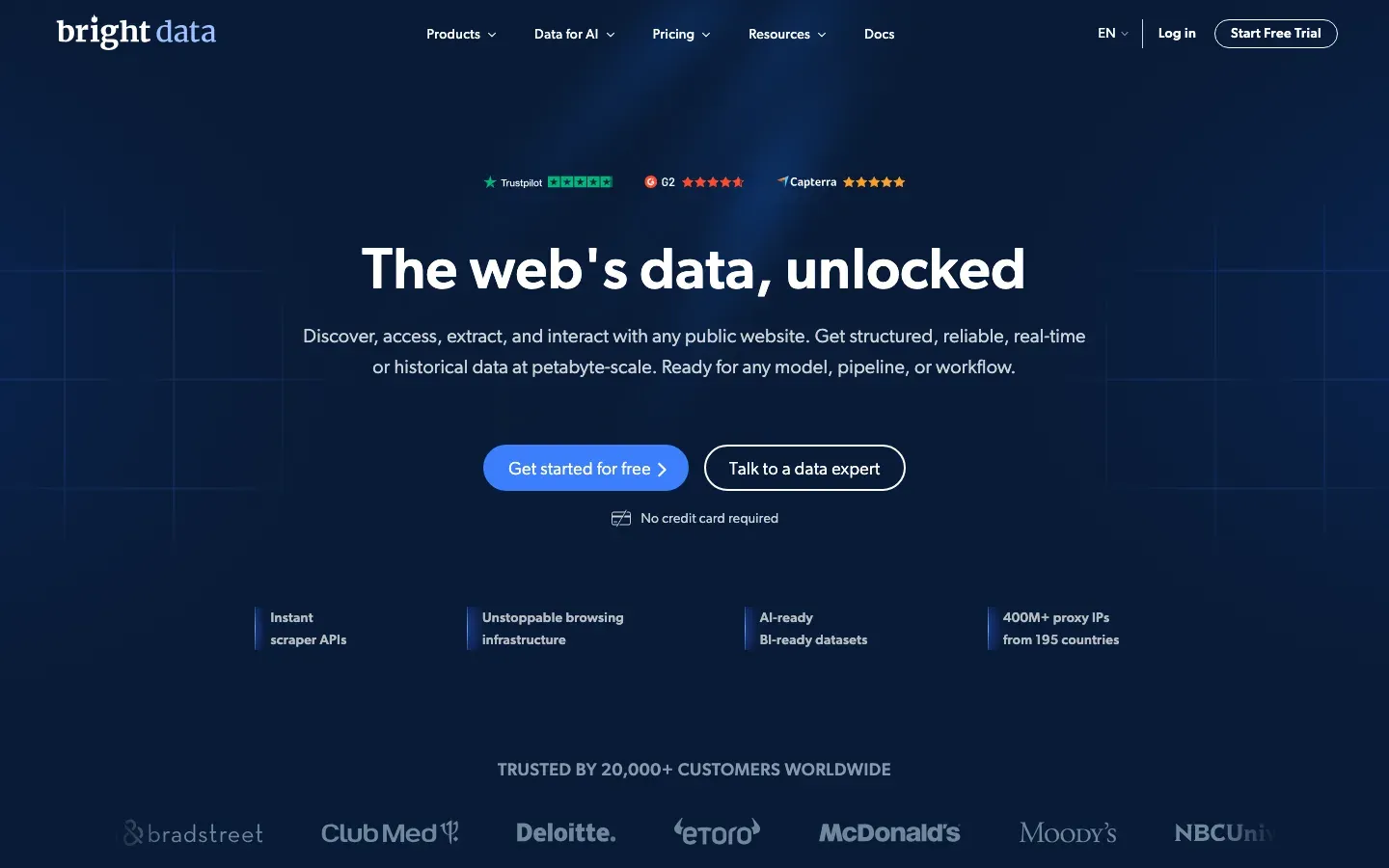
Bright Data’s sweet spot:
- Workloads that need a diverse proxy mix (residential, datacenter, mobile, ISP)
- Compliance-bound enterprises that need SOC 2 and GDPR documentation per request
- Custom infrastructure deals with negotiated SLAs and dedicated account management
- Brand-protection use cases where proxy provenance is part of the legal trail
If your problem is “we need 50 GB of residential bandwidth per day routed through specific countries,” Bright Data is a category leader. If your problem is “we need parsed Google SERPs,” the proxy stack is infrastructure you’re paying for and not really using.
The proxy-vs-product distinction
Two different things sometimes get called “SERP scraping”:
- Proxy plus your own code. The vendor provides clean IPs. You bring the parser, retry logic, AI Overview detection, PAA extraction, and ad sitelink handling.
- Parsed SERP API. The vendor returns the structured envelope. You consume rows, not HTML.
Bright Data leans toward the first model. Their SERP API exists, but the platform is fundamentally a proxy product. You can hit Google through their proxies and parse the response yourself, or use their SERP add-on as a thin wrapper.
cloro leans toward the second model. There is no proxy product to subscribe to. The endpoint returns parsed JSON for every SERP element: organic, ads, AI Overview, PAA, related searches.
What that means for cost
Bright Data’s pricing is multi-axis. Bandwidth is metered per gigabyte of residential traffic. The SERP API tier has its own CPM. Session costs apply on some endpoints. Geo premiums apply for harder-to-route countries. Reading the bill at the end of the month means reconciling several line items.
cloro’s pricing is one axis: per call. 3 credits for the first results page, +2 per additional page, +2 if AI Overview enrichment is enabled. The Hobby plan covers 250,000 credits for $100 per month. There is no bandwidth ledger to balance.
Per-call price at fixed depth
| Depth + AI Overview | cloro | Bright Data SERP API |
|---|---|---|
| n=10 (1 page) + AIO | $1.25 – $2.00 / 1k | n/a (proxy with your parser) |
| n=100 (10 pages) + AIO | $5.75 – $9.20 / 1k | n/a (proxy with your parser) |
Bright Data’s $1 per 1,000 published rate buys raw access; the AI Overview parser, citation extraction, and PAA hydration are work you absorb. cloro’s row reflects the structured envelope returned by /v1/monitor/google directly.
What that means for time-to-first-call
Bright Data’s enterprise onboarding lands in the 3-5 business day range for most teams. cloro’s signup is self-serve: API key in five minutes, first request in ten.
If your team has the procurement runway and needs the underlying proxy infrastructure, the wait pays back. If you’re prototyping a SERP-monitoring workflow or running smaller scale, days of approval to get to the first request is friction without a return.
When Bright Data is the right call
- An active proxy requirement (regulated brand-protection, GDPR-bound geo routing, custom IP-type mix)
- Spend that justifies dedicated account management and a master agreement
- A legal team that needs the compliance documentation Bright Data provides
- SERP scraping bundled with a much larger proxy workload
When cloro is the right call
- You want parsed SERP JSON and have no proxy requirement
- You want self-serve onboarding and per-call billing
- The SERP envelope (organic, ads, AI Overview, PAA, related) is the data you need
The bottom line
Bright Data is a proxy infrastructure company with a SERP API on the side. cloro is a SERP API. If your workload reads “we need clean residential IPs in many countries,” Bright Data is the right shape. If it reads “we need parsed Google SERP data on a developer plan,” the proxy stack is friction the SERP API doesn’t justify.
Feature comparison
How the two stack up, feature by feature
| Feature | cloro | Bright Data |
|---|---|---|
| AI Overview Scraping | Native support with parsed citations and sources | Limited support, requires custom implementation |
| Setup Time | 5 minutes self-service | 3-5 business days with approval |
| Proxy Network Size | Optimized for AI engines (ChatGPT, Perplexity, Copilot) | 72M+ residential IPs in 195+ countries |
| API Design | Modern REST with 99% success rates | Complex enterprise APIs |
| Geolocation Support | Comprehensive coverage for all major markets | 195+ countries |
| LLM Visibility Tracking | Built-in ChatGPT, Perplexity, Copilot monitoring | Not available |
| Pricing Model | Monthly credit-based plans, transparent pricing | Complex CPM/bandwidth pricing with $500+ minimum |
| Developer Experience | Self-service, instant API key, comprehensive docs | Sales process, approval required, account management |
The verdict
Bright Data offers enterprise features and diverse proxy infrastructure at premium pricing with multi-day procurement. cloro is the inverse trade: a single per-call SERP API with AI Overview, citations, and PAA parsed in the default response — at $1.25–$2.00 per 1,000 (n=10 + AIO) vs. Bright Data's $1 per 1,000 raw. Per-unit cost favors Bright Data; total delivered cost (including the parser you would otherwise build and maintain) typically favors cloro. Switch from Bright Data when developer time matters more than the headline CPM.
Frequently asked questions
Is cloro a complete replacement for Bright Data?+
cloro is purpose-built for AI scraping and SERP monitoring with native support for ChatGPT, Perplexity, and Copilot. If you need ChatGPT, Perplexity, or Copilot scraping with parsed citations, cloro is designed specifically for those use cases.
How much can I save by switching from Bright Data to cloro?+
Most teams save on operational time and parser maintenance, not just unit cost. Bright Data charges $1 per 1,000 requests for the proxy/SERP API but doesn't parse AI Overview, citations, or hydrated PAA — you build that. cloro's page-driven Google endpoint runs $1.25–$2.00 per 1,000 at n=10 with AI Overview included on Hobby ($0.40/1k credits) and as low as $5.75 per 1,000 at n=100 + AIO on Enterprise ($0.25/1k credits).
Does cloro offer the same proxy network as Bright Data?+
cloro uses an optimized network for AI engines (ChatGPT, Perplexity, Copilot, Google). Bright Data offers 72M+ residential IPs for diverse scraping use cases. If you need AI scraping and monitoring, cloro is purpose-built for it.
How long does it take to switch from Bright Data to cloro?+
Most teams integrate cloro in under 30 minutes. Sign up, get your API key instantly, and make your first request. Our clean API design and comprehensive documentation make migration straightforward. No sales calls, no approval process.
What features does cloro have that Bright Data doesn't?+
cloro offers native AI scraping (ChatGPT, Perplexity, Copilot) with parsed citations, real-time AI visibility tracking, UULE geolocation parameters, and a modern developer experience with 99% success rates. Bright Data focuses on traditional web scraping and proxy infrastructure.